
Arkansas ODS Permit Practice Test 12
- Questions25
- Correct to pass20
- Passing score80%
- Minimum age14 years
-
1. A law enforcement officer is directing traffic and waves you forward while the signal facing you shows red. What should you do?
Show answer
Answer A: Follow the officer's direction and proceed
Directions given by an officer controlling traffic take priority over signals, signs and pavement markings.
-
2. The signal ahead has a sign prohibiting left turns, and your route needs a left. What should you do?
Show answer
Answer D: Go straight on and find a legal place to turn and come back
A turn prohibition applies to every driver, so you continue through and reach your route by another legal turn.
-
3. What does Arkansas law allow a driver younger than 18 to do with a cell phone while driving?
Show answer
Answer A: Nothing except contact help in an emergency
Arkansas prohibits the use of a cell phone, for talking or for texting, by holders of a Learner's License or an Intermediate License, the credentials issued to drivers under 18, except to deal with an emergency.
-
4. A snow squall cuts visibility to almost nothing while you are on a highway. What must you not do?
Show answer
Answer D: Stop in a travel lane and wait for the squall to blow through
A vehicle stopped in a lane in a whiteout is invisible until someone hits it. Slow gradually and keep moving until you can leave the roadway completely.
-
5. Red pavement markings are used on a roadway to show that
Show answer
Answer A: it must not be entered from that direction
Red markings identify a roadway that is not to be entered or used, and they also mark the pavement of truck escape ramps.
-
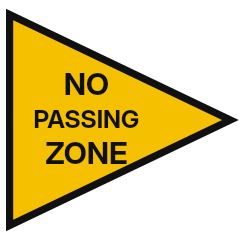
6. Why would a restriction like this one be applied to a stretch of road?
Show answer
Answer A: Because there is not enough visible road ahead to complete a pass safely
Limits on overtaking are set where a hill, a curve or an obstruction leaves too little sight distance for a driver to pull out, pass and return before meeting oncoming traffic.
-
7. How should you handle a prescription or over the counter medicine before driving?
Show answer
Answer D: Read the label and ask a pharmacist or doctor whether it affects driving
Many common medicines, including allergy and cold remedies, cause drowsiness or slowed reactions, and the label or a pharmacist can tell you whether driving is safe.
-
8. An officer directing traffic faces you and holds one hand up with the open palm toward your vehicle. What does the gesture mean?
Show answer
Answer D: Stop before reaching the officer
A raised open palm shown toward a driver is the standard signal to stop.
-
9. Traffic is entering the freeway from a ramp ahead of you and you are in the right lane. What should you do?
Show answer
Answer C: Move to another lane if it is safe, or adjust your speed to make room
Merging drivers may have little room to adjust. Helping them in by changing lanes or easing your speed prevents conflicts even though they must legally yield to you.
-
10. The lane you are in has a right-turn-only arrow painted on the pavement. What must you do?
Show answer
Answer C: Turn right, because a lane-use arrow is a legal requirement
Lane-use arrows painted on the pavement are regulatory markings, so a driver in that lane must travel in the direction shown.
-
11. Your passengers are being noisy and you are losing concentration. What should you do?
Show answer
Answer B: Ask them to settle down, or pull over safely until they do
The driver is responsible for the conditions inside the vehicle, and stopping is always better than driving distracted.
-
12. You are approaching a multilane roundabout. When should you choose your lane?
Show answer
Answer C: Before you enter, using the lane-choice sign on the approach
You select your lane on the approach the way you would at any multilane intersection, then stay in that lane all the way around, because changing lanes inside a roundabout creates side-impact conflicts.
-
13. A sign at the curb reads Tow-Away Zone. What does it mean for you?
Show answer
Answer C: That a vehicle left there can be removed at the owner's expense
In a tow-away zone the vehicle can be removed immediately and the owner pays the towing and storage charges to get it back.
-
14. Where is a U-turn most clearly unsafe and generally prohibited?
Show answer
Answer D: On a curve or near a hill crest, where other drivers cannot see you
U-turns are barred where approaching drivers cannot see you in time, such as on a curve or near the top of a hill.
-
15. How long does Arkansas suspend the license of a driver under 21 for a first underage DUI offense?
Show answer
Answer A: 90 days
A first underage DUI or BUI offense carries a ninety-day suspension in Arkansas, and reinstatement also requires an education or treatment programme and a victim impact panel.
-
16. A sign on a freeway restricts trucks to the two right-hand lanes. What should a car driver expect in those lanes?
Show answer
Answer A: More heavy vehicles and slower changes of speed
A truck lane restriction concentrates heavy vehicles on the right, and those vehicles accelerate, brake and change lanes far more slowly than cars.
-
17. How high can a doubled fine reach for a moving violation committed in an Arkansas work zone?
Show answer
Answer C: $5,000
Fines double for any moving traffic violation in an Arkansas work zone, and the Arkansas manual warns that doubled fines can be as high as five thousand dollars.
-
18. A pedestrian steps off the curb without looking your way. What should you assume?
Show answer
Answer B: That the person has not seen you at all, and be ready to stop for them
Defensive driving means assuming you have not been seen until there is clear evidence that you have.
-
19. In what form may an Arkansas driver show proof of insurance to an examiner or an officer?
Show answer
Answer B: On paper or on an electronic card
Arkansas accepts proof of insurance as a paper card or in electronic form, and the manual lists either as acceptable when a driver appears for the skills exam.
-
20. What must an Arkansas officer investigating a crash do when a driver was using a wireless device at the time?
Show answer
Answer C: Note the device use on the written accident form
Arkansas Code 27-51-1506 requires the investigating law enforcement officer to indicate on the written accident form that the driver was using a wireless telecommunications device.
-
21. How long does an Arkansas driver have to request a hearing after receiving a notice of security requirement or suspension following a crash?
Show answer
Answer C: Twenty days from receipt of the notice
A written request for a hearing to determine whether a judgment may be rendered must reach the Office of Driver Services within twenty days of receiving the notice.
-
22. Traffic is heavy and crawling where a sign warns that your lane ends and two lanes must become one. What is the best practice?
Show answer
Answer C: Use the lane to the end, then take turns merging one by one
In stop-and-go traffic the zipper merge, using both lanes up to the merge point and then alternating, keeps the queue shorter and traffic moving; in free-flowing traffic move over as soon as it is safe.
-
23. How many points does Arkansas assess for passing a school bus that is displaying its warning not to pass?
Show answer
Answer C: 8 points
Passing a school bus displaying a warning not to pass carries eight points in the Arkansas schedule, the same as reckless driving and hit and run.
-
24. How much moving water is generally enough to float and carry away most passenger vehicles?
Show answer
Answer D: About one foot
About a foot of moving water will float most cars, and even less will stall an engine. That is why the rule is to turn around instead of judging the depth.
-
25. You are making a U-turn at a signal on a green left arrow. Who must you still watch for?
Show answer
Answer D: People in the crosswalk you will cross as you come around
Even a protected arrow does not clear the crosswalk, and a U-turn sweeps across a crosswalk that pedestrians may already be using.