
Arkansas ODS Permit Practice Test 15
- Questions25
- Correct to pass20
- Passing score80%
- Minimum age14 years
-
1. You are following a tractor-trailer so closely that its rear doors fill your windshield. What is the main problem?
Show answer
Answer D: You cannot see the road ahead and the truck driver cannot see you
A truck has a deep blind spot directly behind it, and tailgating also hides everything in front of the truck from you. Drop back so you can see and be seen.
-
2. You are driving in fog so thick that you can barely see the vehicle ahead. Which pavement marking is the best guide for staying in your lane?
Show answer
Answer A: The white edge line on the right side of the road
The right edge line keeps you positioned away from oncoming traffic and is easy to follow at low speed. Following tail lights closely tempts you to drive faster than you can see.
-
3. What is lane splitting?
Show answer
Answer B: A motorcycle riding between two lanes of traffic moving the same way
Lane splitting means riding along the line between two lanes of traffic going in the same direction rather than staying within a lane.
-
4. Why is smooth, early braking better than hard, late braking?
Show answer
Answer D: It keeps you in control and gives the driver behind more warning
Braking early and gently keeps the tires well within their grip and gives following drivers time to react to your brake lights.
-
5. A short driver cannot get ten inches between the chest and the steering wheel airbag. What is the answer?
Show answer
Answer D: Move the seat back and tilt the wheel downward, or fit pedal extenders
Distance from the airbag is gained by moving the seat back and aiming the wheel at the chest, using pedal extenders if the pedals are then out of reach.
-
6. A sign shows a lane joining from the right with no merge required. What does that mean?
Show answer
Answer B: The joining traffic gets its own new lane, so nobody has to merge
An added lane means the roadway gains a lane at that point, so entering vehicles have somewhere to go without anyone changing lanes.
-
7. When is a driver or rider most likely to need hand and arm signals instead of the vehicle turn signal lamps?
Show answer
Answer D: When the lamps have failed or cannot be seen because of glare or a load
Hand and arm signals replace or reinforce the lamps whenever the lamps do not work or cannot be seen clearly by other road users.
-
8. Where does the restriction that starts at this sign come to an end?
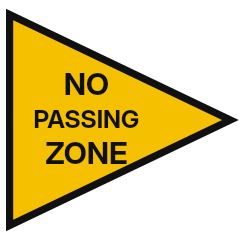
Show answer
Answer D: Where the centerline markings show that overtaking is allowed again
The sign marks the start of the restricted section, and the centerline markings along the road show how far it runs and where overtaking becomes lawful again.
-
9. A farm implement ahead of you on a two-lane road is wider than its own lane. What should you do?
Show answer
Answer D: Hang back until you can see past it and pass only with a clear road
Wide equipment hides the road ahead and may extend farther across the center line than it appears, so the pass needs more room and a much better view.
-
10. You turn from asphalt onto a loose gravel road. What should you do about your speed?
Show answer
Answer D: Lower it, since grip is reduced and stopping takes longer
Loose gravel gives far less grip than pavement, so speed must come down for both steering and stopping.
-
11. You hear a bang and one of the front tires deflates while you are on the highway. What happens to the vehicle?
Show answer
Answer D: It pulls strongly toward the side that failed
The collapsed tire drags heavily on that corner, so the vehicle veers toward it. Hold the wheel firmly, keep your line and let the speed fall before leaving the road.
-
12. What is the purpose of a wide solid white line painted straight across your lane on the approach to an intersection?
Show answer
Answer C: It shows the point where a required stop must be made
A stop line indicates the point at which the stop required by a signal or a stop sign is to be made, ahead of the crosswalk and the intersection.
-
13. Why is backing up on a freeway or on its shoulder prohibited?
Show answer
Answer A: Traffic arrives far too fast to expect a vehicle moving the wrong way
Freeway traffic closes on a stopped or reversing vehicle at highway speed and has almost no time to react to something moving against the flow.
-
14. Under the Arkansas Protection from Secondhand Smoke for Children Act, smoking tobacco in a vehicle is prohibited when a passenger is younger than what age?
Show answer
Answer B: 14 years old
Arkansas prohibits knowingly smoking tobacco in a motor vehicle when a child under fourteen years of age is a passenger.
-
15. The road ahead is broken up with potholes and rough patches. What should you do?
Show answer
Answer C: Slow down, since a hole hit at speed can wreck a tire or wheel
A lower speed cuts the impact on tires, wheels and suspension and gives you time to choose a line through the rough surface.
-
16. You are turning right onto a one-way street. Which lane of that street should you enter?
Show answer
Answer C: The lane closest to the right curb
Even though every lane on a one-way street runs your way, a right turn must end in the lane nearest the right curb; you may change lanes afterwards when it is safe.
-
17. In a work zone a flagger is directing traffic in a way that conflicts with the posted signs. Whom do you follow?
Show answer
Answer B: The flagger's directions
A flagger controls traffic through a work area that changes from day to day, and those instructions take precedence over the fixed signs and markings in that zone.
-
18. Your green left-turn arrow goes out and a steady green ball stays lit. What may you do?
Show answer
Answer A: Continue turning left, but only after yielding to oncoming traffic
When the arrow ends and a green ball remains, the turn changes from protected to permissive, so it is still allowed but oncoming traffic goes first.
-
19. What is meant by keeping a space cushion?
Show answer
Answer C: Keeping open space on all sides of your vehicle so you always have somewhere to go
Open space ahead, behind and to the sides gives you time to react and an escape path when a hazard appears, which is the core idea of defensive driving.
-
20. The sign over the leftmost lane reads LEFT LANE MUST TURN LEFT. You are in that lane and want to go straight. What should you do?
Show answer
Answer C: Move out of the lane before the intersection if it is safe
A mandatory movement lane control sign makes the turn compulsory for that lane, so a driver who wants another movement must change lanes in advance.
-
21. What does this sign require of the driver?
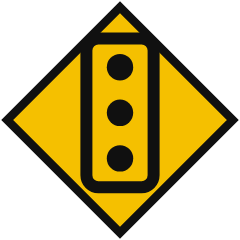
Show answer
Answer D: Reducing speed and being ready to stop at the intersection ahead
The advance notice asks the driver to slow and be ready to stop, while whether a stop is actually needed depends on the indication displayed on arrival.
-
22. A school bus ahead of you has its red lights flashing and its stop arm extended. What are you required to do?
Show answer
Answer A: Stop and stay stopped until the lights stop flashing and the bus starts moving
Flashing red lights and an extended stop arm mean children are getting on or off, so traffic must stop and wait until the bus withdraws the signals and moves again.
-
23. You turn the wheel but the front of the vehicle keeps sliding straight ahead on a slippery road. What should you do?
Show answer
Answer C: Ease off the accelerator and reduce the steering angle until the front tires grip again
A front-wheel skid means the tires are asking for more grip than the surface can give. Less speed and less steering angle let them regain traction.
-
24. You brake hard on a wet road and need to steer around a stalled car. How do antilock brakes help you do that?
Show answer
Answer B: They stop the wheels locking, so the tires can still turn the vehicle
Locked wheels slide and cannot change direction. By preventing lockup the system lets you brake at full force and steer at the same time.
-
25. In slow summer traffic the temperature gauge climbs into the red. What should you do first?
Show answer
Answer A: Turn off the air conditioner and turn on the heater to draw heat from the engine
The heater core acts as an extra radiator, and shutting off the air conditioner reduces engine load. If the gauge keeps climbing, pull over and shut off the engine, and never open a hot radiator cap.