
Arkansas ODS Permit Practice Test 2
- Questions25
- Correct to pass20
- Passing score80%
- Minimum age14 years
-
1. In the code that governs pavement markings, what does a double line stand for?
Show answer
Answer B: A maximum restriction
The marking code is consistent: a double line means the strongest restriction, a solid line discourages or forbids crossing, and a broken line is permissive.
-
2. The red oil pressure warning light comes on while you are driving. What should you do?
Show answer
Answer C: Pull over safely as soon as possible and shut off the engine
Loss of oil pressure means the engine is no longer being lubricated and can be destroyed within minutes. Stop, shut down and check before restarting.
-
3. Your light turns green, but a vehicle from the cross street is still finishing a turn inside the intersection. What should you do?
Show answer
Answer B: Wait until that vehicle has cleared the intersection
A green indication lets you proceed only after yielding to pedestrians in the crosswalk and to vehicles already lawfully within the intersection.
-
4. You have turned onto a ramp at night and your headlights pick out large white arrows painted on the pavement pointing straight back at you. What do they mean?
Show answer
Answer C: You are traveling against the flow and must turn back
Wrong-way arrows are laid so that a driver going the correct way never sees them head on, so an arrow pointing at you means you are on the ramp backwards.
-
5. Your vehicle is burning at the roadside. How far away should everyone keep?
Show answer
Answer D: At least a hundred feet away from the vehicle and upwind, out of the drifting smoke
Burning vehicles give off toxic smoke and parts such as tires and struts can burst, so keep a long distance and stay upwind.
-
6. You are driving on a road covered with a layer of wet fallen leaves. What should you expect?
Show answer
Answer B: As little grip as on ice, plus hidden markings and hidden holes
Wet leaves are as slippery as ice and they hide the lane lines and any potholes underneath, so slow well before curves and stops.
-
7. The vehicle you want to pass is traveling close to the speed limit. What should you do?
Show answer
Answer C: Stay behind, because a pass may not take you over the limit
The speed limit applies while passing too. If you cannot complete the pass without exceeding it, do not start the pass.
-
8. A sign with a black legend on a fluorescent pink background is used for
Show answer
Answer A: traffic incident management
Fluorescent pink is set aside for signing that manages traffic around a crash, a spill or another unplanned incident, so it stands apart from routine work zone orange.
-
9. What do yellow lines painted on a roadway separate?
Show answer
Answer D: Traffic moving in opposite directions
Yellow markings separate opposing streams of traffic, and they also mark the left edge of a divided highway or a one-way roadway.
-
10. At 45 mph you look at a navigation screen for four seconds. Roughly how far do you travel unseeing?
Show answer
Answer D: About 260 feet
At 45 mph you cover roughly 66 feet a second, so four seconds on a screen is around 260 feet of road that you never looked at.
-
11. You are calling 911 to report a crash. Which information matters most?
Show answer
Answer C: The exact location, how many people are hurt and any hazard such as fire
Dispatchers need to know where to send help, how much help to send, and what dangers the crews will meet on arrival.
-
12. What must you be sure of before you pull out to pass on a two-lane road?
Show answer
Answer A: That the road ahead is clear far enough for the whole pass
You need enough clear road to pull out, pass and return before any oncoming vehicle arrives, and you must judge that distance before you start.
-
13. A city transit bus at a stop ahead of you switches on its left signal. What should you do?
Show answer
Answer D: Slow and let the bus pull back into traffic
A bus needs a long gap to rejoin traffic, and yielding to a signaling transit bus keeps the whole line of traffic moving safely.
-
14. The gates at a railroad crossing begin to come down as you approach. What must you do?
Show answer
Answer A: Stop and wait until the gates are fully raised and the lights stop flashing
Once the gates start down you must stop clear of the tracks and wait until they are fully raised and the warning lights have stopped.
-
15. What does electronic stability control do that ordinary brakes cannot?
Show answer
Answer C: It brakes single wheels to bring the vehicle back on your intended path
The system compares where you have steered with where the vehicle is actually going, then brakes individual wheels to pull it back into line.
-
16. A bicyclist ahead of you puts the left arm straight out to the side. What is being signaled?
Show answer
Answer B: A left turn or a move to the left
The left arm held straight out is the bicycle signal for a left turn, so hold back and give the rider room to cross toward the center.
-
17. During which hours may an Arkansas Intermediate License holder not drive without a qualifying adult or a listed exception?
Show answer
Answer D: Between 11:00 p.m. and 4:00 a.m.
Arkansas prohibits Intermediate License holders from driving between 11:00 p.m. and 4:00 a.m. unless accompanied by a licensed driver 21 or older, or traveling to or from school, church, work or an emergency.
-
18. Your vehicle has a backup camera. What is the right way to use it?
Show answer
Answer C: Use it as an aid, but still turn and look behind you
A camera has a limited field of view and can be dirty or wet, so it supplements looking over your shoulder and using the mirrors rather than replacing them.
-
19. Why does safety guidance say a child should ride in the back seat rather than in front of an active passenger airbag?
Show answer
Answer D: Because the airbag inflates with enough force to injure a small child badly
Airbags deploy at very high speed and are sized for adults, so a child seated close to one can be badly hurt by the bag itself, which is why the back seat is recommended for children.
-
20. Your vehicle has a blind spot warning light in the door mirror. What should that mean for your habits?
Show answer
Answer B: You still check the blind spot yourself, because the system can miss a rider
Blind spot systems are an aid, not a substitute, and a motorcycle or a bicycle can be missed or arrive faster than the sensor expects.
-
21. The light ahead is green, but traffic beyond the intersection is backed up so far that you could not clear it. What is the correct action?
Show answer
Answer D: Wait behind the stop line until there is room on the far side
Entering an intersection you cannot clear blocks cross traffic and pedestrians, so you should hold your position until space opens on the other side.
-
22. What do white lane lines painted between travel lanes indicate?
Show answer
Answer A: Traffic in the adjacent lane moves in the same direction as you
White markings separate lanes carrying traffic in the same direction and mark the right edge of the roadway.
-
23. What does a sign reading Slower Traffic Keep Right require?
Show answer
Answer C: Traffic moving slower than the general flow must use the right-hand lane
The sign applies to any vehicle traveling below the speed of the traffic around it, which must keep right so faster vehicles can use the lanes to the left.
-
24. A driver is thinking about overtaking a slower vehicle and sees this sign a short distance ahead. What does it mean for that pass?
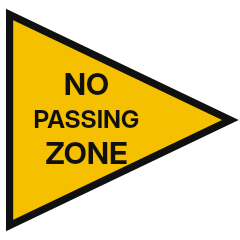
Show answer
Answer B: The pass must be finished before the restricted section begins
The sign marks the start of a section where passing is prohibited, so a driver may not be on the left side of the road beyond it; any pass has to be completed before that point or not started at all.
-
25. Where do you find how much weight your vehicle may carry?
Show answer
Answer C: On the placard in the driver door opening
The certification placard in the driver door opening gives the load limit and the recommended cold tire pressures for the vehicle as built.