
Arkansas ODS Permit Practice Test 29
- Questions25
- Correct to pass20
- Passing score80%
- Minimum age14 years
-
1. How does Arkansas classify driving a vehicle that is not adequately insured when it is involved in a crash?
Show answer
Answer A: As a Class A misdemeanor
Arkansas Code 27-22-105 makes the operator of an inadequately insured vehicle involved in an accident guilty of a Class A misdemeanor.
-
2. May you park at the curb immediately next to a railroad crossing?
Show answer
Answer A: No, you must leave the crossing and its approach clear
Parking beside a crossing hides the tracks and the signals from approaching drivers and leaves no room for a vehicle that has to clear the rails.
-
3. How does Arkansas classify speeding by more than 15 miles per hour over the posted limit on a county road?
Show answer
Answer D: As a Class C misdemeanor
Arkansas Code 27-51-216 makes a person guilty of a Class C misdemeanor for exceeding a county road speed limit by more than fifteen miles per hour.
-
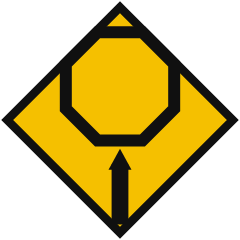
4. What is the driver expected to do after passing this sign?
Show answer
Answer A: Begin slowing so that a complete stop can be made at the intersection ahead
It is used where the control at the intersection stays hidden until late, so braking should begin here rather than at the stop line.
-
5. You have stopped on an uphill grade close behind a large truck at a traffic signal. What is the risk?
Show answer
Answer B: The truck may roll back into you when it starts to move
Heavy vehicles can roll backward a short distance when the driver moves from the brake to the accelerator on a hill. Leave extra room when stopped behind a truck on a grade.
-
6. While you are still on an entrance ramp, where should your attention be?
Show answer
Answer D: Along the ramp ahead and back at the highway traffic in the mirrors and over your shoulder
A merge needs both halves of the picture at once: the ramp curving ahead of you and the traffic you are about to join behind and to your left.
-
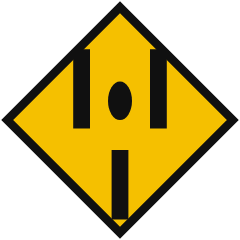
7. What must a driver be ready for beyond this sign?
Show answer
Answer C: Vehicles approaching from the opposite direction in the next lane over
The separation between the two directions runs out, so from that point oncoming vehicles share the same pavement and the driver has to keep right.
-
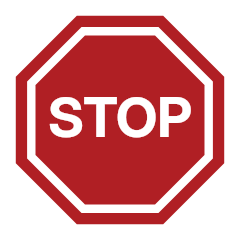
8. At an intersection where every approach carries this sign, two drivers arrive at exactly the same instant. Which of them goes first?
Show answer
Answer C: The driver on the right
Order of arrival decides who goes first, and when two vehicles arrive together the driver on the right proceeds while the other gives way.
-
9. A rectangular marker with alternating black and retroreflective yellow stripes set at a slant is used to
Show answer
Answer C: mark an obstruction, with the stripes sloping down toward the side on which traffic should pass
This striped panel is an object marker, and the direction in which the stripes slope shows the driver which side of the obstruction to pass on.
-
10. At night you are waiting to turn left and can see only the headlights of an approaching vehicle. Why should you allow a bigger margin?
Show answer
Answer D: Because lights alone make speed and distance hard to judge
With no other visual cues, two points of light give you very little information about how fast the vehicle is closing, so leave extra margin.
-
11. You are turning left into a street that is divided by a raised median. Which side should you enter?
Show answer
Answer C: The right-hand roadway, so that you travel on the proper side
A raised median separates two directions of travel, so the turn must be completed into the roadway carrying traffic your way.
-
12. Your power steering fails while you are driving. What happens and what should you do?
Show answer
Answer B: Steering becomes much harder but still works, so slow down and pull off the road
Without power assistance the steering still works, but it takes much more effort, especially at low speed. Keep both hands on the wheel and get off the road.
-
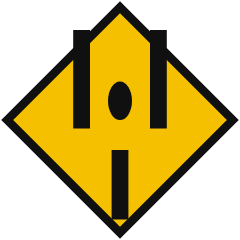
13. What change in the road does this sign announce?
Show answer
Answer B: The two directions of travel are about to be separated, and the driver must keep to the right of the separation
Ahead the roadway splits into separate one-way roadways on either side of a median, so the driver stays to the right of the divider and no longer meets oncoming vehicles.
-
14. Why does a heavier vehicle need more room to stop than a light one from the same speed?
Show answer
Answer B: Because there is more mass in motion for the tires to slow down
More mass means more energy at the same speed, and the brakes and tires need more distance to get rid of it.
-
15. A barricade carries a sign reading ROAD CLOSED TO THROUGH TRAFFIC. What does it permit?
Show answer
Answer B: Local access for people whose destination is on that road
This closure keeps out drivers who are only passing through while still allowing residents and deliveries to reach addresses within the closed section.
-
16. Your vehicle has stalled on railroad tracks and no train is in sight. After getting everyone away, whom should you call first?
Show answer
Answer B: The railroad emergency number posted on the blue sign at the crossing, giving the crossing number
Every public crossing has a blue emergency notification sign with a phone number and a crossing identification number. That call lets the railroad stop or slow trains before they reach you.
-
17. How does alcohol affect a driver's ability to handle several things at once?
Show answer
Answer B: It cuts the ability to divide attention between tasks
Driving means watching the road, the mirrors and the instruments together, and alcohol narrows attention so that one of those tasks is dropped without the driver noticing.
-
18. Why is a sign reading BRIDGE ICES BEFORE ROAD worth heeding even when the road itself is merely wet?
Show answer
Answer C: Cold air passes under a bridge as well as over it
A bridge deck loses heat from below as well as above, so it can be frozen while the road on either side of it is only wet.
-
19. What is the proper use of the horn?
Show answer
Answer C: To give a brief warning when another road user may not have seen you
The horn is a warning device meant to alert someone to your presence when a collision is possible, and using it in anger tends to escalate conflict rather than prevent crashes.
-
20. Why should your thumbs rest along the rim rather than hook inside the spokes?
Show answer
Answer D: A jolt can spin the wheel and injure hooked thumbs
A pothole or a dropped wheel can snap the wheel round violently, and thumbs hooked through the spokes are trapped when it happens.
-
21. A row of solid white triangles points toward you across your lane. What does it mark?
Show answer
Answer A: The place to yield to traffic or people ahead
A yield line of triangles shows drivers exactly where to give way, and it is used at roundabouts and at midblock crosswalks.
-
22. Your car has side curtain airbags. What should you avoid doing?
Show answer
Answer B: Resting your head against the window or the door pillar
A side airbag deploys from the pillar or roof rail, so a head leaning against that area is directly in its path.
-
23. A driver disregards this sign and turns so as to travel against the direction it establishes. What is the immediate danger?
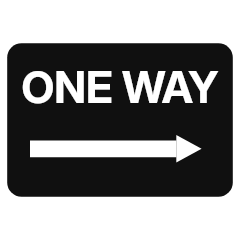
Show answer
Answer D: The driver will face traffic head on, because every lane comes the other way
Turning against the established direction puts the vehicle nose to nose with all the traffic on that street, which is why the mistake has to be corrected at once.
-
24. What are front fog lights for?
Show answer
Answer D: Adding a low, wide beam close to the car when visibility is poor
Fog lights throw a low, wide beam under the fog, which is why they are mounted low and are used only in poor visibility.
-
25. In a vehicle with automatic transmission, which foot should operate the brake and accelerator?
Show answer
Answer D: The right foot for both pedals
Using only the right foot prevents pressing both pedals at once and keeps the response the same in every vehicle you drive. The left foot rests on the floor or the footrest.