
Arkansas ODS Permit Practice Test 31
- Questions25
- Correct to pass20
- Passing score80%
- Minimum age14 years
-
1. There is a driveway and a side street between you and the corner where you will turn right. When should you signal?
Show answer
Answer C: After passing the openings, so nobody pulls out in front of you
A signal switched on before an opening tells drivers waiting there that you are turning in, and they may pull out into your path.
-
2. What field of vision does Arkansas require of a driver's license applicant?
Show answer
Answer D: 140 degrees with two functional eyes, 105 degrees with one
Arkansas Code 27-16-704 sets the field of vision standard at 140 degrees for a person with two functional eyes and 105 degrees for a person with one functional eye.
-
3. In Arkansas, at what alcohol concentration can a driver younger than 21 be arrested for Underage Driving Under the Influence?
Show answer
Answer B: 0.02 percent
Arkansas sets the underage threshold at a breath or blood alcohol concentration of 0.02 percent, well below the adult limit.
-
4. Why is parking too close to a street corner prohibited?
Show answer
Answer D: Because it hides approaching traffic and pedestrians
A vehicle parked at a corner blocks the view that both drivers and pedestrians need before entering the intersection.
-
5. A large electronic advertising sign beside the road catches your eye. What should you do?
Show answer
Answer A: Glance briefly and return your eyes to the road
Bright changing displays are designed to hold attention, so treat them like any roadside object and give them no more than a brief glance.
-
6. You are following closely behind a vehicle you intend to pass on a two-lane road. What should you do first?
Show answer
Answer D: Drop back to give yourself room to build speed before you pull out
From close behind you cannot see far enough ahead and you have no room to gather speed, so the pass takes longer and starts blind.
-
7. You must stop for a train at a highway-rail crossing. Where should you stop?
Show answer
Answer B: Behind the stop line, gate or signal and well clear of the nearest rail
Stop behind the stop line, gate or flashing-light signal and well clear of the nearest rail, because a train overhangs its track by several feet on each side.
-
8. When does an Arkansas Class D license issued to an applicant who is at least 18 but under 21 expire?
Show answer
Answer C: One month after the holder turns 21
A Class D license issued between 18 and 21 is prorated and runs out one month past the holder's twenty-first birthday, when a full-term license can be bought.
-
9. You want to reverse direction but the street is too narrow for a U-turn. What is the alternative?
Show answer
Answer D: Make a three-point turn, or go around the block in heavy traffic
Where there is not enough width for a U-turn, the three-point turn does the job in stages, and on a busy street going around the block is safer still.
-
10. How is the Arkansas seat belt law enforced for a driver or front-seat passenger who is not buckled?
Show answer
Answer B: As a primary violation, so an officer may stop the vehicle for it alone
Since June 30, 2009 Arkansas allows a traffic stop based solely on an unbelted driver or front-seat passenger, and the fine may not exceed twenty-five dollars plus court costs.
-
11. What speed limit applies on an Arkansas county road when the county judge has not established one?
Show answer
Answer C: 40 miles per hour
Arkansas Code 27-51-216 lets each county judge set speed limits on county roads, and where none has been established the limit is 40 miles per hour.
-
12. You are traveling beside another vehicle on a multilane highway at nearly the same speed. Why is this a poor position?
Show answer
Answer B: You may be sitting in that driver's blind spot with nowhere to go if they move over
Driving alongside removes your side escape route and often puts you where the other driver cannot see you. Speed up or drop back to open space beside you.
-
13. In the Arkansas driver improvement point system, how many points trigger an automatically scheduled administrative hearing?
Show answer
Answer B: 14 or more points
Arkansas automatically schedules a hearing when a driver reaches 14 or more points; a warning letter is mailed earlier, when the driver reaches 10 points.
-
14. You carry reflective warning triangles in your car. How should they be used after a breakdown?
Show answer
Answer B: Set out behind the vehicle, far enough back to warn traffic before it arrives
A warning device works only if drivers see it in time to react, so it is placed well back along the road they are traveling.
-
15. Traffic safety experts describe three kinds of driver distraction. Which set is correct?
Show answer
Answer A: Visual, manual and cognitive
Distraction takes the eyes off the road, the hands off the controls or the mind off driving, and many activities do more than one of those at once.
-
16. How may an Arkansas driver who is at least 18 but younger than 21 use a wireless telephone while driving?
Show answer
Answer D: Only in hands-free mode, with handheld use limited to emergencies
An Arkansas Class D driver who is at least 18 but under 21 may use a hands-free wireless device, and a handheld phone only for emergencies.
-
17. The light ahead is green but traffic beyond the intersection is backed up. What should you do?
Show answer
Answer B: Wait behind the intersection until there is room to clear it completely
You may not enter an intersection unless you can get completely through it, because stopping inside blocks cross traffic when the signal changes.
-
18. You are about to open your door after parking on the traffic side of the street. What should you do first?
Show answer
Answer C: Check the mirror and look back for approaching vehicles and bicyclists before opening the door
A door opened into traffic can strike a passing bicyclist or vehicle, so you check behind you first and keep the door open no longer than necessary.
-
19. A driver on a hands free call looks straight at a red light and drives through it. What best explains this?
Show answer
Answer B: The eyes saw it but the brain did not process it
Attention, not eyesight, decides what a driver actually sees, and a loaded mind can leave a driver looking straight at a hazard without registering it.
-
20. A yellow lamp flashes above a warning sign at a sharp curve. What does it ask of a driver?
Show answer
Answer D: Slow down and pass the point with extra care
A warning beacon draws attention to the sign it is mounted with, and the message of the sign is what the driver must act on.
-
21. A sign on a divided highway reads Keep Right Except to Pass. What does it require of you?
Show answer
Answer A: Use the left lane only to overtake, then return to a lane on the right
The left lane on such a highway is reserved for overtaking, so a driver who has finished a pass must move back to the right.
-
22. Where is this sign installed in relation to the hazard it announces?
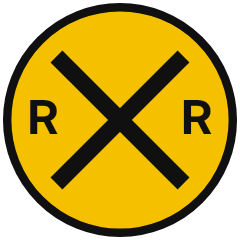
Show answer
Answer A: Far enough before the hazard that a driver can slow down and stop short of it
This is an advance warning sign, placed on the approach so a driver has time to react before reaching a crossing that a curve or a crest may be hiding.
-
23. How does a NO OUTLET sign differ from a DEAD END sign?
Show answer
Answer B: It warns that a whole group of streets has no way out
No Outlet is posted where the road leads into a network of streets from which there is no through route, while Dead End refers to the single street itself.
-
24. You are driving slower than the general flow on a multilane highway. Which lane should you use?
Show answer
Answer D: The right lane, keeping the left lanes free for faster traffic and passing
Slower traffic must keep right so that faster vehicles and overtaking traffic can use the left lanes without weaving between lanes.
-
25. On a street with parking along the curb, the shared lane marking is painted well out from the curb face. What does that placement tell a bicyclist?
Show answer
Answer C: To ride clear of the doors of parked cars
The marking is set at least eleven feet from the curb where parking is allowed so that riders are guided outside the reach of an opening door.