
Arkansas ODS Permit Practice Test 40
- Questions25
- Correct to pass20
- Passing score80%
- Minimum age14 years
-
1. A motorcycle ahead of you has its turn signal blinking but continues straight through several intersections. What is the likely explanation?
Show answer
Answer D: Motorcycle signals often do not cancel themselves after a turn
Many motorcycle turn signals are not self-cancelling, so a rider may leave one on by mistake. Wait until the rider actually starts to turn before you act on the signal.
-
2. You have just passed a vehicle on a two-lane road. When may you return to your lane?
Show answer
Answer B: When you can see the whole vehicle in your inside mirror
Seeing the entire vehicle you passed in your rearview mirror shows there is room to pull back in without cutting it off.
-
3. What does a traction control system do?
Show answer
Answer A: It limits wheel spin when you accelerate
Traction control cuts power or brakes a spinning wheel so the tires can grip when you pull away or accelerate on a slippery surface.
-
4. A yellow horizontal rectangular sign showing one large arrow pointing left or right, facing traffic on the far side of a sharp bend, tells the driver
Show answer
Answer C: which way the roadway turns at that point
The large arrow sign is mounted on the outside of a sharp change in alignment so that a driver approaching head on immediately sees which way the road goes.
-
5. You reach a four-way stop after another driver has already stopped there. What should you do?
Show answer
Answer D: Let the driver who stopped first proceed before you go
At a four-way stop the vehicles proceed in the order they arrived, so a driver who stopped before you goes first.
-
6. What belongs in a basic emergency kit carried in a car?
Show answer
Answer D: A flashlight, a first aid kit, jumper cables and some warning devices
A useful kit lets you see, be seen, treat an injury and restart the vehicle; carrying loose gasoline is a fire risk.
-
7. You signaled a lane change and the signal did not switch itself off afterwards. Why does that matter?
Show answer
Answer B: Other drivers may act on a turn you do not intend to make
A signal left on tells other drivers you are about to turn, and someone may pull out in front of you. Cancel it as soon as the maneuver is finished.
-
8. You arrive at an intersection where the traffic signals are completely dark after a power failure. What should you do?
Show answer
Answer A: Treat the intersection as an all-way stop and take turns
When a signal is dark or out of order, drivers on every approach must stop and proceed in turn, exactly as at a four-way stop.
-
9. Halfway through a curve you realize you are going too fast. What is the best response?
Show answer
Answer C: Ease off the gas gently and look where you want to go
Easing off transfers a little weight to the front tires without upsetting the balance, and looking through the curve keeps your steering smooth.
-
10. You are using the parking brake to slow a vehicle whose brakes have failed. How should you apply it?
Show answer
Answer D: Gradually, holding the release so you can let it off if the rear slides
The parking brake works on two wheels only, so applying it hard can lock them and spin the vehicle. Keep the release held so you can back it off instantly.
-
11. A piece of farm machinery ahead of you is wider than its own lane. What should you do?
Show answer
Answer C: Hold back until you can see far enough to pass safely
Wide equipment leaves no gap inside the lane and may use part of the other side, so a pass needs a long clear view of the road ahead.
-
12. What is a marked loading zone for?
Show answer
Answer A: Loading and unloading only, not for general parking
A loading zone is reserved for actively loading or unloading goods or passengers; leaving a vehicle there for other reasons is a parking violation.
-
13. The trapezoid sign shape is associated with
Show answer
Answer C: recreational and cultural interest area signing
The trapezoid is used for recreational and cultural interest area guide signs and for national forest route markers.
-
14. Why should you avoid parking over tall dry grass or a pile of dead leaves?
Show answer
Answer B: Because the hot exhaust can set the dry material on fire
The exhaust system stays hot for a long time after a drive and can ignite dry vegetation underneath the vehicle.
-
15. Lights set into the pavement along both edges of a crosswalk start to flash yellow as you approach. What do they tell you?
Show answer
Answer D: Someone is crossing and has to be given way
In-roadway warning lights flash only when a pedestrian activates the crossing, so a flashing pattern means somebody is in or entering the crosswalk.
-
16. You are approaching the crest of a hill and cannot see the road beyond it. What should you do?
Show answer
Answer C: Slow down and keep well to the right
Beyond a blind crest there may be a stopped vehicle, a cyclist or an oncoming driver crossing the center line, so reduce speed and hold your own side.
-
17. You are parking facing downhill on a street with a curb. Which way should the front wheels point?
Show answer
Answer A: Toward the curb, so the vehicle would roll into it if it moved
Turning the wheels toward the curb when facing downhill means a vehicle that starts to roll is stopped by the curb instead of entering the traffic lane.
-
18. Your vehicle has daytime running lights. Why should you still switch on the headlights at dusk?
Show answer
Answer B: Daytime running lights usually do not light the tail lights, so you are hard to see from behind
On many vehicles the daytime running lights illuminate only the front. Without the headlight switch on, the rear of the vehicle stays dark and the dash may still look lit.
-
19. You are driving on a rural road with no sidewalk. Where should you expect to meet pedestrians?
Show answer
Answer A: Walking toward you on your side of the road
Where there is no sidewalk, pedestrians are taught to walk facing traffic, so they appear on your side of the road coming toward you.
-
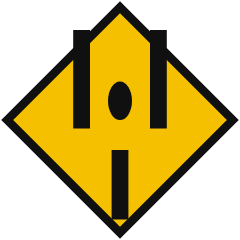
20. Beyond the point this sign refers to, which movement becomes unlawful?
Show answer
Answer D: Driving on the far side of the separation, against the flow
Once the two directions are separated, each roadway carries one-way traffic, so crossing to the other side means driving into oncoming vehicles.
-
21. How long does Arkansas suspend a driver's license for a first refusal to submit to a chemical test?
Show answer
Answer A: 180 days
Under the Arkansas implied consent rules a first refusal to test carries a 180-day suspension, longer than the six months imposed for a first DWI conviction.
-
22. A person who is not an Arkansas resident but is physically present in the state must obtain an Arkansas driver's license after how long?
Show answer
Answer A: Six months
Arkansas Code 27-16-606 requires a nonresident who has been physically present in the state for six months to obtain an Arkansas driver's license.
-
23. A yellow diamond shows the two edges of the road pinching toward each other. What does it mean?
Show answer
Answer B: The pavement gets narrower but the lanes continue
The road narrows sign warns that the traveled way becomes tighter, leaving less room beside passing vehicles even though no lane is dropped.
-
24. A driver is following you far too closely. What is the best response?
Show answer
Answer D: Increase your own following distance and let the driver pass when it is safe
More room ahead of you means you can slow gradually instead of braking hard, which reduces the chance of being struck from behind, and letting the driver by removes the problem entirely.
-
25. A fire truck with lights and siren has just passed you and is heading down the same road. How closely may you follow it?
Show answer
Answer B: Well back, because following a responding emergency vehicle closely is illegal
Following a responding emergency vehicle closely is prohibited; the exact minimum distance is set by each state, so stay far enough back to keep the scene and other responders clear.