
Arkansas ODS Motorcycle Practice Test 15
- Questions25
- Correct to pass20
- Passing score80%
- Minimum age16 years
-
1. A deer crosses the road in front of you and disappears into the trees. What should you expect?
Show answer
Answer B: That other deer are likely to follow it across the very same stretch of road
Deer usually move in groups, so one crossing the road is a warning that more may follow.
-
2. You are traveling beside a tractor-trailer and cannot see the truck driver's face in any of the truck's mirrors. What does that tell you?
Show answer
Answer A: The truck driver probably cannot see your vehicle
Large trucks have deep blind spots on all four sides, so if the driver's face is not visible in a mirror the driver has no view of you. Move ahead or drop back until you are out of that area.
-
3. You notice a bulge on the sidewall of one of your tires. What should you do?
Show answer
Answer D: Have the tire replaced before driving far, because it could blow out
A sidewall bulge means the internal cords have broken and only the rubber is holding the air. The tire can fail suddenly at any speed.
-
4. What makes a left turn protected rather than permissive?
Show answer
Answer B: Oncoming traffic is held by a red signal while you have a green arrow
A protected turn is one where the conflicting movements are stopped by their own signal, which is what the green arrow indicates.
-
5. What is the danger of releasing the brake too early when moving off uphill?
Show answer
Answer C: The motorcycle rolls backward before the clutch has taken hold
On a grade the brake has to stay on until the engine is actually pulling, otherwise the machine runs back into whatever is behind it.
-
6. A large truck ahead of you swings toward the left just before turning right at an intersection. What should you do?
Show answer
Answer B: Stay back and never try to move into the gap between the truck and the curb
Long vehicles need extra room and often swing wide to complete a right turn, so the space that opens on their right closes again as the trailer sweeps through it.
-
7. How should a rider approach a curve whose radius keeps tightening the further you go into it?
Show answer
Answer A: Enter more slowly than the curve first appears to need, saving lean for the exit
In a decreasing radius curve the sharpest part comes last, so a slower entry leaves both speed and lean angle in reserve for where they are needed.
-
8. A load has been packed onto the seat behind you. What else must it not do?
Show answer
Answer A: Restrict how you move on the seat or reach the controls
Baggage that pins the rider in place or gets in the way of the handlebars and levers takes away the control the rider needs in an emergency.
-
9. In the T-CLOCS pre-ride inspection, what does the first item cover?
Show answer
Answer C: Tires and wheels
T stands for tires and wheels, where the rider checks pressure, tread, damage, rims, spokes and bearings before anything else.
-
10. What fine range does Arkansas set for a second or later violation of its texting while driving law?
Show answer
Answer C: $50 to $500
Arkansas Code 27-51-1506 raises the penalty for each subsequent violation to a fine of not less than fifty dollars and not more than five hundred dollars.
-
11. You have just been involved in a crash on a city street. Which sequence of first steps is correct?
Show answer
Answer A: Stop where you are, check everyone for injuries, and then make the scene safe
You are required to stop, and the first priority at the scene is people, followed by preventing a second collision.
-
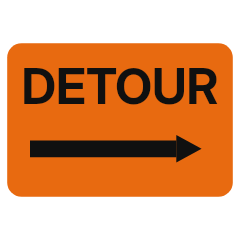
12. Which of these is true of the roadway a driver is being sent onto here?
Show answer
Answer D: Its own signs, signals and speed limits govern for the whole way around
The alternate route is an ordinary public road, so every control posted on it governs as usual; being sent that way grants no extra priority and no relief from the limits in force there.
-
13. Which family of signs normally uses a rectangle that is wider than it is tall?
Show answer
Answer B: Guide signs, which name routes and destinations
Guide signs are laid out as horizontal rectangles because they have to carry route numbers, place names and distances side by side.
-
14. What must an Arkansas motorcycle applicant aged 16 or 17 provide in addition to passing the required exams?
Show answer
Answer D: An original birth certificate and a parent or legal guardian signature on the application
Arkansas requires applicants between 16 and 17 years of age to submit an original birth certificate and to have a parent or legal guardian sign the application.
-
15. How is the rear brake applied on a standard motorcycle?
Show answer
Answer D: By pressing down a pedal with the right foot
The rear brake pedal is in front of the right footrest and should be pressed down smoothly rather than stamped on.
-
16. The vehicle you want to pass is traveling close to the speed limit. What should you do?
Show answer
Answer C: Stay behind, because a pass may not take you over the limit
The speed limit applies while passing too. If you cannot complete the pass without exceeding it, do not start the pass.
-
17. An emergency vehicle with flashing lights and a siren is approaching from behind on a two-way street. What should you do?
Show answer
Answer C: Pull over to the right edge of the road and stop until it passes
Clearing a path by pulling to the right and stopping gives the emergency vehicle a predictable route, while stopping in mid-lane or inside an intersection blocks that path.
-
18. When does Arkansas law forbid a driver of any age to use a wireless telecommunications device in a highway work zone?
Show answer
Answer D: When a highway worker is present
Arkansas Code 27-51-1606 prohibits using a wireless telecommunications device while driving in a highway work zone when a highway worker is present, except in an emergency.
-
19. A single solid white line separates two lanes running in the same direction. What is it telling drivers?
Show answer
Answer A: Changing lanes there is discouraged
A solid white lane line discourages lane changing, typically where merging or weaving would create a hazard.
-
20. Where among these is parking specifically prohibited?
Show answer
Answer A: On a bridge, in a tunnel or on railroad tracks
Bridges and tunnels have no safe refuge and cannot be widened, and a vehicle left on railroad tracks cannot be avoided by an approaching train.
-
21. During a pre-ride check, what should the throttle do when it is released?
Show answer
Answer A: Snap back to the closed position on its own
A throttle that does not close by itself can leave the engine running fast when the rider expects it to slow, so a sticking cable must be repaired before riding.
-
22. You want to move into the right lane just as an entrance ramp joins the highway at that point. What is the better choice?
Show answer
Answer B: Wait until you are past the merge area so you do not squeeze the entering traffic
The merge area is where ramp traffic has to find a gap, so adding a lane change of your own into the same space creates a conflict.
-
23. A sign showing a walking figure inside a red circle with a diagonal slash stands at the start of a bridge. What does it mean?
Show answer
Answer C: People on foot may not use that roadway
The no pedestrians sign excludes people on foot from that roadway altogether, which is common on high-speed bridges and freeways.
-
24. How should a rider dress for a long ride in very hot weather?
Show answer
Answer C: In ventilated riding gear that still covers the arms and legs
Mesh and vented riding gear flows air while keeping its abrasion protection and shading the skin, so heat is not a reason to ride uncovered.
-
25. What is the danger of riding in cold weather with thin gloves?
Show answer
Answer C: Cold, numb hands respond slowly and lose their feel for the controls
Wind chill at riding speed cools the hands quickly, and numb fingers are slower and less precise on the clutch, throttle and brake.