
Arkansas ODS Motorcycle Practice Test 23
- Questions25
- Correct to pass20
- Passing score80%
- Minimum age16 years
-
1. Besides a chemical test, what else supports an impaired driving charge?
Show answer
Answer B: The officer's observations of the driving and the driver
Weaving, slow responses, speech and balance observed by the officer are evidence in their own right, which is why a driver can be charged on behavior alone.
-
2. You have stopped at a stop sign, but a parked truck blocks your view along the cross street. What should you do?
Show answer
Answer A: Creep forward slowly and stop again where you can see
When something blocks the view, a second stop closer to the intersection is the only safe way to see, and it must come before your vehicle enters the traffic lane.
-
3. May you stop in a marked bicycle lane to let a passenger out?
Show answer
Answer B: No, stopping there forces riders into the traffic lane
A vehicle stopped in a bike lane pushes riders out into moving traffic, which is exactly what the lane exists to prevent.
-
4. What speed limit applies when passing an Arkansas school building or school zone during school hours while children are present and outside the building?
Show answer
Answer A: 25 miles per hour
Arkansas Code 27-51-212 forbids driving faster than 25 miles per hour past a school building or school zone during school hours when children are present and outside the building.
-
5. What is a rider looking for when inspecting the control cables?
Show answer
Answer A: Kinks, fraying and stiff or notchy movement
A frayed strand or a kinked outer will eventually jam or snap, which can leave a rider without a clutch, a throttle or a front brake.
-
6. A vehicle is sitting in your blind spot and you need to change into that lane. What should you do?
Show answer
Answer B: Adjust your speed to open a clear gap, then check again and move over
Changing your speed either drops the other vehicle behind you or lets it move ahead, which turns the blind spot back into open space.
-
7. What does this sign warn a driver about?
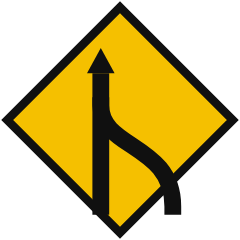
Show answer
Answer A: Traffic from another roadway will enter the same lane ahead
Two traffic streams come together into one lane beyond this point, so drivers on both roadways have to adjust speed and spacing to fit together.
-
8. An arrow panel in a work zone shows four flashing lamps in caution mode instead of an arrow. What does that display mean?
Show answer
Answer A: Warning only, so pass the work area with caution in your current lane
Caution mode gives a general warning without directing a lane change, so drivers stay alert and pass the activity with care.
-
9. What does a light drag of the rear brake do during a slow, tight turn?
Show answer
Answer C: It steadies the motorcycle and smooths out the power reaching the rear wheel
Working the rear brake against a slipping clutch takes the jerkiness out of the drivetrain and holds the machine steady through the turn.
-
10. On a hot summer day you notice long black strips of crack sealant snaking across the pavement. What should a rider know about them?
Show answer
Answer A: They soften in heat and can be slippery, especially under a leaned tire
Crack sealant gets soft and greasy in the heat, so treat those strips as a low traction surface and avoid braking or hard cornering on them.
-
11. You realize you have driven several miles without remembering any of it. What kind of distraction is this?
Show answer
Answer C: Cognitive distraction, because your mind was not on driving
Daydreaming or being lost in thought is a cognitive distraction. Your eyes may be on the road, but your brain is not processing what they see.
-
12. In a work zone, the flagger's instructions conflict with the pavement markings still visible on the road. Which do you follow?
Show answer
Answer B: The flagger, because a person directing traffic outranks the markings
An authorized flagger controlling a temporary traffic control zone overrides signs, signals and markings, and drivers must obey the flagger's signals.
-
13. Why is passing on a curve prohibited even when the traffic seems light?
Show answer
Answer C: You cannot see far enough around it to know the lane is clear
A pass is only as safe as the distance you can see, and a curve hides the very lane the maneuver uses.
-
14. Why is a pothole a bigger problem for a motorcycle than for a car?
Show answer
Answer C: A motorcycle has only two wheels, so an impact can deflect it off line
A car crosses a hole on four wheels and stays balanced, while a hole can knock a motorcycle off its line or damage a wheel, so scan the pavement well ahead and plan a path around holes.
-
15. How far ahead should you normally be looking as you drive?
Show answer
Answer C: About 12 to 15 seconds ahead, well beyond the vehicle in front
Looking that far down the road lets you see a problem developing and slow smoothly, instead of discovering it in time only for hard braking.
-
16. A white arrow painted in your lane points only to the right, and a sign above the lane shows the same movement. What must you do?
Show answer
Answer C: Turn right from that lane
Pavement arrows used with lane-use signs are regulatory, so a driver occupying that lane must make the movement shown.
-
17. When may a driver of a motor vehicle use a marked bicycle lane?
Show answer
Answer C: Only to cross it when turning or entering the road where the markings allow
A bike lane is a lane for cyclists. Motor vehicles may only cross it to enter or leave the road or to make a turn where the markings permit.
-
18. You are clear of the tracks after your vehicle stalled on a crossing. Whom should you contact?
Show answer
Answer C: The emergency number posted on the blue sign at the crossing, or 911
Grade crossings carry an emergency notification sign with a railroad phone number and a crossing identification number so that approaching trains can be stopped, and 911 works if that sign is not visible.
-
19. A deer has just crossed in front of you on a stretch signed for animal crossings. What is the best assumption?
Show answer
Answer B: More animals are likely to follow the first one
Deer travel in groups, so one animal crossing usually means others are about to follow, and a driver should slow and keep scanning both shoulders.
-
20. On a long uphill grade a second lane opens on the right and a sign directs slower traffic into it. You are towing a trailer and holding up a line of vehicles. What should you do?
Show answer
Answer A: Move into the right-hand lane and let the faster traffic use the left lane
A climbing lane exists so that slow vehicles can be passed safely, and the slower vehicle is the one that belongs in it.
-
21. Where is a road work ahead sign placed?
Show answer
Answer B: In advance of the work space or detour, so drivers are warned before reaching it
Advance warning signs are placed upstream of the work space or detour so that drivers have time to slow down and change lanes before reaching the activity.
-
22. A yellow diamond reading DIP warns a driver about
Show answer
Answer A: a short, sharp depression in the road surface
A dip is an abrupt low point that can jolt a vehicle or scrape its underside, so speed should be reduced before reaching it.
-
23. The low sun is directly ahead and glare makes it hard to see. What should you do?
Show answer
Answer C: Slow down, use the sun visor or sunglasses, and increase following distance
Sun glare can hide pedestrians, brake lights and signals. Reducing speed and adding space gives you time to react to what you cannot yet see.
-
24. A rider in the middle of the group pulls over onto the shoulder. What should the sweep rider do?
Show answer
Answer C: Stop and stay with that rider while the rest of the group continues
The sweep exists so that no rider is ever left alone at the roadside, while the remainder of the group carries on to a safe place to wait.
-
25. Where is a U-turn generally the most reasonable choice?
Show answer
Answer B: At an intersection where it is permitted and you can see well both ways
A U-turn needs a legal place and a long clear view in both directions, which is why a permitted intersection with open sight lines is the usual choice.