
Arkansas ODS Motorcycle Practice Test 9
- Questions25
- Correct to pass20
- Passing score80%
- Minimum age16 years
-
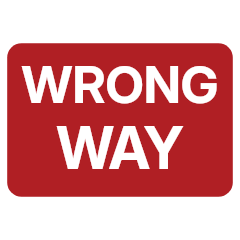
1. This sign comes into view ahead of a driver who has already started along a ramp. What should the driver do?
Show answer
Answer B: Pull clear where it is safe, then turn around and leave the ramp traveling properly
The driver is traveling against the legal flow, so the safest response is to stop clear of the lanes, turn the vehicle around and get off the ramp before meeting traffic head on.
-
2. Your light is green but the traffic beyond the intersection is stopped and there is no room on the far side. What should you do?
Show answer
Answer A: Wait behind the line until you can clear the far side
Entering an intersection you cannot clear blocks the cross traffic when their signal turns green, so you wait behind the line.
-
3. A yellow diamond showing two vertical arrows, one pointing up and one pointing down, warns that
Show answer
Answer A: the road ahead carries traffic in both directions
The two-way traffic sign warns that the roadway ahead is not divided and that vehicles will be coming from the opposite direction.
-
4. The handlebars begin to shake violently in a wobble at speed. What is the correct response?
Show answer
Answer C: Grip the bars firmly and close the throttle gradually, without braking
Braking or accelerating during a wobble usually makes it worse, so the rider holds on, rolls off gradually, and pulls off the road to find the cause.
-
5. You must leave your vehicle beside a narrow rural road at night. What should you do?
Show answer
Answer B: Get it right off the pavement and switch on the hazard lights
A vehicle left on an unlit rural road is very hard to see, so move it completely clear of the traveled surface and mark it with the hazard lights.
-
6. In heavy stop-and-go traffic, why does using both lanes right up to a merge point help?
Show answer
Answer D: It stores the queue in two lanes, so the backup is shorter
Filling both lanes halves the length of the queue and keeps it away from the traffic upstream, which is why alternating at the merge point works better when traffic is slow.
-
7. Is dictating a message by voice a safe alternative to typing one?
Show answer
Answer C: No, it still takes attention from driving
Composing and checking a spoken message loads the mind and usually pulls the eyes to the screen anyway, so research finds it no safer than other phone use.
-
8. What happens to your field of vision as your speed increases?
Show answer
Answer C: It narrows, so you notice less at the sides of the road
The faster you travel, the more your useful field of view narrows toward the center, so a hazard coming from the side is seen late or missed altogether.
-
9. Who decides which chemical test an Arkansas driver suspected of DWI must take?
Show answer
Answer C: The law enforcement officer
The Arkansas manual states that the law enforcement officer chooses which test to request, and a driver who refuses can lose the license.
-
10. You are riding a city street with embedded streetcar rails and it has just started to rain. What is the added risk?
Show answer
Answer D: Wet steel rails offer very little grip, and so does the pavement beside them
Steel rails give almost no traction when wet, so cross them upright at as close to a right angle as the lane allows, without braking or turning on the metal.
-
11. How far ahead should you normally be looking while driving?
Show answer
Answer D: About 12 to 15 seconds of travel ahead
Looking that far ahead, roughly a block in town and much farther on a highway, gives you time to see a problem developing and adjust before it becomes an emergency.
-
12. How long does a passed Arkansas motorcycle knowledge exam remain valid?
Show answer
Answer A: One year
Arkansas keeps the motorcycle knowledge exam result valid for one year, so the remaining steps must be finished within that period.
-
13. A yellow diamond showing a bicycle is posted on a rural road. What should a driver expect?
Show answer
Answer A: Bicyclists crossing or riding along the roadway there
The bicycle warning sign is used where a bikeway crosses the road or where riders are likely to be in the traffic lanes, so drivers should look carefully and pass wide.
-
14. How much space should you hold behind the rider who is directly ahead of you in your own portion of the lane?
Show answer
Answer D: At least two seconds
Riders sharing the same track keep a following distance of at least two seconds so they have the time and the room to react to a hazard.
-
15. A yellow diamond on an exit ramp shows a truck tipping over onto two wheels. Which drivers does it concern most?
Show answer
Answer D: Those in tall vehicles carrying a high load
The truck rollover sign warns that the curve can overturn a vehicle with a high center of gravity, so such drivers must slow well below the normal ramp speed.
-
16. Your light turns green, but a vehicle is still in the middle of the intersection. What should you do?
Show answer
Answer D: Wait until the intersection is clear before you move ahead
A green light means go only when the way is clear. Drivers already inside the intersection must be allowed to finish crossing.
-
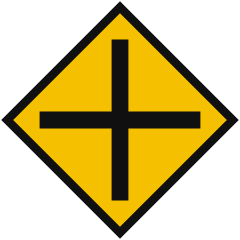
17. Does this sign settle who has the right-of-way at the intersection ahead?
Show answer
Answer D: No, it only gives notice of the intersection; the control there decides priority
A warning prepares the driver for what is coming but grants no priority, so whatever stop control, yield control, signal or right-of-way rule applies at the intersection is what decides.
-
18. What happens when tires are driven underinflated for a long time?
Show answer
Answer D: They wear at the edges, they run hot and they are more likely to fail
An underinflated tire flexes too much, which wears the shoulders and builds up heat that can destroy the tire.
-
19. At a four-way stop another driver pulls out ahead of you when it was clearly your turn. What is the correct response?
Show answer
Answer B: Let that driver go through, then take your turn when the way is clear again
Right of way is something you give, never something you take, so yielding to a driver who takes it wrongly avoids a crash you would otherwise share.
-
20. Why should riders avoid the center strip of the lane, especially where traffic stops often?
Show answer
Answer A: Because it collects oil and grease dripped from other vehicles
Drippings from other vehicles build up in the center of the lane, and the buildup is heaviest at busy intersections and toll booths where traffic sits waiting.
-
21. What is the correct order of actions when passing a vehicle on a two lane road?
Show answer
Answer D: Signal, check the mirrors and blind spot, pass in the left lane, signal and return
The rider signals and checks behind before moving out, completes the pass in the passing lane, then signals and checks again before returning.
-
22. You notice at night that one of your headlights has burned out. What should you do?
Show answer
Answer B: Get it replaced promptly, because other drivers may take you for a motorcycle
A single light makes your vehicle look narrower and further away, so other drivers misjudge you, and one light is also illegal.
-
23. What is meant by keeping a space cushion?
Show answer
Answer C: Keeping open space on all sides of your vehicle so you always have somewhere to go
Open space ahead, behind and to the sides gives you time to react and an escape path when a hazard appears, which is the core idea of defensive driving.
-
24. The neutral light is on, but you are not sure the transmission is really out of gear. How can you confirm it?
Show answer
Answer B: Release the clutch and rock the motorcycle to see whether it rolls freely
A machine that rolls without resistance while the clutch is released is genuinely in neutral, which a burnt out or faulty neutral switch cannot tell you.
-
25. You make eye contact with a driver waiting to pull out of a side street. What should you assume?
Show answer
Answer D: The driver may still not have seen you, so stay ready to slow or stop
Drivers can look directly at you and still not register your vehicle, especially a small one. Eye contact helps, but never rely on it.